Category: Uncategorized

  • Zero Trust for AI Workloads: From Identity to GPU Infrastructure

    Imagine this- it’s 10:15 a.m. Your teammate opens a chat with an internal AI assistant and asks it to gather the latest contract language about a vendor. They run a prompt, click “OK” and let the assistant analyze the documents and summarize the next steps.

    The user is authenticated.

    The agent has a managed identity.

    The API call uses mutual Transport Layer Security (mTLS) and reaches a private inference endpoint inside the organization’s virtual network.

    Are you done?

    If the answer is yes, you’re missing part of the problem.

    Those controls are necessary. They just aren’t sufficient anymore.

    Once artificial intelligence systems introduce agents, models, retrieval systems, vector databases, and graphics processing unit (GPU)-backed infrastructure into the call chain, the Zero Trust question gets considerably bigger.

    We’re no longer asking only:

    Who is authenticated?

    We’re asking:

    Who or what is acting? What artifact is running? What data is being accessed? Where is it running? And why is that action being taken?

    That’s the shift I think security architects need to make when applying Zero Trust to AI.

    Zero Trust still works. The trust boundary gets bigger.

    The fundamentals of Zero Trust haven’t changed.

    Zero Trust Architecture (ZTA) is still about explicitly verifying access, enforcing least privilege, assuming compromise, and continuously evaluating the environment rather than trusting something simply because it sits inside a network boundary.

    The difference is that AI gives us a lot more things to verify.

    A traditional application might have a user, an application, a database, and a network around it. An AI workload can have a user, an agent, several tools, a retrieval service, a vector database, a model, model weights, containers, a host operating system, drivers, and GPUs.

    Each of those components can become part of an attack path.

    That means the policy decision has to account for more than the user’s identity and the resource they’re requesting. A Policy Decision Point (PDP)—the component that decides whether an action should be allowed—may need additional evidence about the model, workload, runtime, data, and environment.

    The Policy Enforcement Point (PEP) then enforces that decision.

    The basic Zero Trust model hasn’t been replaced.

    We’ve expanded what the policy decision needs to know.

    The identity problem: humans are only one principal

    This is probably the easiest place to start.

    In an AI system, the person sitting at the keyboard is only one identity in the system.

    There may also be a workload running the model server, an agent acting on the user’s behalf, a retrieval service accessing documents, and tools that the agent can call.

    Those identities need to be distinct.

    Consider an agent that uses a developer’s long-lived credentials. If that agent is compromised, the attacker doesn’t just gain access to the agent. They potentially inherit everything that developer was allowed to do.

    That’s a terrible blast radius.

    Instead, agents and workloads should have their own managed identities and short-lived credentials. In Kubernetes (K8s), service accounts can be mapped to cloud workload identities so that individual workloads can be identified and authorized independently.

    Microsoft Entra Workload Identity is one practical way to implement this pattern in Azure.

    The important idea isn’t the Microsoft product, though.

    It’s identity separation.

    An agent should not become a proxy for the human who created it.

    That distinction becomes even more important when agents are ephemeral, automatically created, or capable of taking actions without a human approving every individual step.

    Authorization has to understand the action, not just the actor

    Role-Based Access Control (RBAC) remains useful. If someone is an administrator, developer, or analyst, that role still tells us something about what they’re allowed to do.

    But AI introduces situations where role alone isn’t enough.

    Attribute-Based Access Control (ABAC) evaluates additional information—attributes about the identity, resource, environment, or requested action.

    That’s where AI gets interesting.

    Imagine an agent is authorized to use an internal ticketing system. That doesn’t necessarily mean it should be allowed to export every ticket in the system.

    The authorization decision might need to consider the following:

    • Which agent is making the request
    • Which model is running it
    • Whether that model is an approved artifact
    • Whether the workload is running in an approved environment
    • What data the request touches
    • What operation the agent is attempting
    • What the stated purpose of the action is

    Instead of granting the agent broad access to the tool, the system can make an authorization decision at the point of the individual request.

    That’s the direction per-call authorization takes Zero Trust.

    It’s also where some of the hardest unsolved problems begin. Expressing something as simple as “this agent can reconcile invoices for this vendor but cannot export the underlying financial records” requires more than traditional role assignments.

    Purpose-bound or semantic authorization is still an emerging area. The architecture should account for it without pretending the industry has already solved it.

    RAG turns your data store into part of the AI’s security boundary

    Retrieval-Augmented Generation (RAG) is straightforward in concept: instead of relying only on what a model learned during training, the system retrieves external information and gives that information to the model as context.

    It’s incredibly useful.

    It’s also a security boundary.

    If the retrieval system can access sensitive documents, an attacker who compromises that system—or manipulates the documents going into it—may be able to influence what the model sees.

    That makes the vector database more than an AI component.

    Treat it like a sensitive database.

    Use private networking, strict authentication, authorization around retrieval, and logging that tells you what information was retrieved and by whom.

    Provenance matters here too.

    If a response was generated using five internal documents, you should be able to determine which documents were retrieved and connect those retrieval events to the user, agent, and model involved.

    That gives security teams something they desperately need with AI: a way to reconstruct what actually happened.

    There’s another problem.

    A malicious document can become an instruction to the model.

    That’s prompt injection.

    The attacker doesn’t necessarily need to compromise the database itself. They may only need to get malicious content into the retrieval corpus and wait for an AI system to consume it.

    So the security boundary isn’t simply:

    User → AI

    It’s:

    User → Agent → Retriever → Documents → Model

    Every step deserves scrutiny.

    Models need a software supply-chain mindset

    We already know how dangerous an untrusted software artifact can be.

    A model shouldn’t receive special treatment simply because it happens to contain neural-network weights instead of executable application code.

    Model artifacts should have identifiable provenance, integrity protections, and deployment controls.

    A Software Bill of Materials (SBOM) is an inventory of the components that make up a software artifact. Supply-chain Levels for Software Artifacts (SLSA) provides a framework for improving software build provenance and supply-chain integrity.

    The exact implementation for machine-learning models is still evolving, but the underlying idea is useful: know where the model came from, what produced it, and whether the artifact being deployed is the artifact that was approved.

    Cryptographically signing a model can establish origin and integrity.

    It cannot establish that the model is safe.

    A malicious model can be perfectly signed.

    A poisoned training dataset can produce a perfectly signed model.

    A legitimate model can still behave badly when combined with malicious retrieved data or an overly privileged agent.

    That’s why signed artifacts should be combined with staged deployment, testing, canary releases, rollback capability, and runtime monitoring.

    Provenance tells you what you deployed. It doesn’t tell you that what you deployed is good.

    Eventually, Zero Trust reaches the GPU

    This is where the discussion gets much more interesting.

    The model doesn’t exist in isolation.

    It runs in the container, operating system, drivers, firmware, host, and GPU.

    Kubernetes provides the orchestration layer for many modern AI deployments, and the same security fundamentals apply: signed container images, admission controls, appropriate Kubernetes security policies, workload identities, and strong separation between workloads.

    But GPU workloads introduce another layer of risk.

    GPUs aren’t simply oversized CPUs. They have their own memory architectures, drivers, firmware, scheduling behavior, and hardware-specific attack surfaces.

    A shared GPU environment can therefore introduce risks that don’t exist—or don’t look the same—in a conventional CPU workload.

    For sensitive workloads, dedicated GPU nodes or validated hardware partitioning can reduce those risks. Error-Correcting Code (ECC) telemetry, GPU utilization, memory behavior, driver versions, and host state can also provide useful security signals.

    For particularly sensitive workloads, confidential computing can provide another layer of protection.

    A Trusted Execution Environment (TEE) is designed to protect workloads and data while they’re being processed. Confidential GPU infrastructure extends that concept into GPU-backed workloads and can provide additional attestation information about the environment.

    That’s useful, not magic.

    Confidential computing doesn’t make every hardware attack disappear, and it doesn’t eliminate every microarchitectural, firmware, or driver vulnerability. Research into GPU-specific attacks—including GPUHammer-style attacks—demonstrates why hardware isolation should be treated as one layer of defense rather than the entire security strategy.

    The broader Zero Trust lesson is straightforward:

    Don’t stop verifying at the application boundary.

    Verify the environment that actually runs the application.

    You can’t secure what you can’t see

    Eventually, all of these controls come back to telemetry.

    If an incident occurs, security teams need to know which model was running, where it was running, what data it retrieved, what tools the agent called, and what the underlying infrastructure looked like at the time.

    That means AI environments need more than traditional application logs.

    Useful signals include:

    • Model version and cryptographic hashes
    • Agent and tool-call traces
    • Retrieval events and document identifiers
    • Data provenance
    • Host and workload attestation
    • Driver and firmware state
    • GPU errors and abnormal utilization
    • Redacted inputs and outputs where appropriate

    Those events can feed a Security Information and Event Management (SIEM) platform such as Microsoft Sentinel, along with other security telemetry.

    The goal isn’t to log everything because logging everything sounds secure.

    The goal is to make the attack path reconstructable.

    If a model is compromised, can you identify every workload that ran that model?

    If an agent token is stolen, can you determine which tools it accessed?

    If a malicious document entered a RAG system, can you determine which responses used it?

    If a GPU node shows abnormal behavior, can you identify which workloads were running there?

    That’s the level of visibility Zero Trust for AI should be moving toward.

    What this looks like in Azure

    Azure provides a useful reference architecture because many of these capabilities already exist as cloud primitives.

    Microsoft Entra ID can provide human and workload identity. Entra Workload Identity can extend that model into Kubernetes workloads and agents.

    Azure Key Vault can broker access to secrets and cryptographic keys rather than leaving long-lived credentials embedded in applications.

    Azure Kubernetes Service (AKS) can provide the orchestration layer, with dedicated GPU node pools, admission controls, signed container images, and workload identity mapping.

    Private endpoints and virtual networks can isolate sensitive inference and retrieval infrastructure from unnecessary network exposure.

    Azure Attestation and confidential-computing capabilities can provide additional evidence about workload and platform state for sensitive deployments.

    Azure Monitor and Microsoft Sentinel can collect the resulting telemetry.

    None of these services, individually, creates Zero Trust for AI.

    That’s the wrong way to think about the architecture.

    The services are enforcement and evidence mechanisms.

    The actual architecture is the policy model connecting them.

    A practical starting point

    If I were implementing this incrementally, I wouldn’t try to build the entire thing at once.

    I’d start here:

    1. Give every workload and agent its own identity. Avoid shared credentials and long-lived secrets.
    2. Control what agents can actually do. Don’t confuse permission to use a tool with permission to perform every operation that tool exposes.
    3. Treat RAG data as sensitive data. Secure the vector store, control retrieval, and maintain provenance.
    4. Establish model provenance. Sign approved model artifacts and maintain build and deployment records.
    5. Harden the runtime. Use signed containers, admission controls, workload isolation, and dedicated GPU infrastructure where the risk warrants it.
    6. Collect AI-specific telemetry. Know which model ran, what data it retrieved, what tools it called, and where it ran.
    7. Build toward richer authorization. Incorporate artifact integrity, runtime attestation, data sensitivity, and action context into policy decisions as the technology matures.

    That’s a much more realistic starting point than trying to build some mythical “AI Zero Trust platform” in one shot.

    What we still haven’t solved

    There are some uncomfortable gaps.

    Purpose-bound authorization is still immature. There isn’t a universal way to express and enforce complex statements about what an AI agent is allowed to accomplish.

    Model provenance standards are still developing. SBOM-style approaches and signed artifacts are useful, but there isn’t one universally adopted model-provenance format that solves the problem.

    GPU security is also an active area of research. Hardware attestation and confidential computing can reduce risk, but they don’t eliminate every hardware-level attack.

    And perhaps the hardest problem is behavioral.

    A model can be legitimately built, legitimately signed, legitimately deployed, and still contain a subtle backdoor or behave unexpectedly under a specific trigger.

    We don’t have a magic attestation mechanism that proves an AI system will behave safely.

    That means we’re back to a security principle that predates AI:

    Defense in depth still wins.

    The bigger Zero Trust question

    If you already understand traditional Zero Trust, the important change isn’t that you need to throw away everything you’ve learned.

    You don’t.

    Strong identity still matters. Least privilege still matters. Segmentation still matters. Continuous monitoring still matters.

    What changes is what you’re applying those principles to.

    The trust boundary expands from:

    User → Network → Application

    toward:

    User → Agent → Tool → Data → Model → Runtime → Host → GPU

    At every step, we should be asking the same basic question:

    What am I trusting, and what evidence do I have that I should trust it?

    That’s the real challenge of Zero Trust for AI.

    The human is still part of the security decision.

    They’re just no longer the whole decision.

  • 5 Tips for Pursuing a Degree as a Busy Adult

    Photo by Kampus Production on Pexels.com

    Being a student while being a full-time adult is no joke! The 9-5 job, parenting, fitness, and home chores can have you overburdened and overwhelmed easily. When education is thrown into the mix, the likelihood of burnout is real.

    At one point this year, I absolutely burned out. The support of family, friends, and the workplace are paramount when pursuing higher education. I put together five tips I’ve leaned into for balancing online education with everyday life, along with practical solutions for the challenges that come up.

    1. Carve Out a Realistic Study Schedule

    Challenge: Between work, kids’ soccer games, the gym, and household chores, finding consistent study time feels impossible. Sometimes, my fiancé feels neglected when I’m glued to my laptop instead of spending quality time together. I also feel as though I am neglecting my family, at times. In turn, that feeling can further feed into the burnout.
    Solution: Create a study schedule that respects your family’s rhythm. I sit down with my fiancé whenever I can to discuss my plan for the week. Typically, I block off 1-2 hours for studying when the kids are asleep or during my lunch breaks.

    During weekends, time for coursework increases. Between chores and family activities, you can openly communicate a “breakaway” session to knock out some tasks. For example, the kid goes somewhere else to play, such as a neighbor- perfect time to outline and research for an assignment.

    2. Communicate Openly with Your Spouse or Partner

    Challenge: My partner wants to support my education but sometimes feels overwhelmed if I get overwhelmed. It’s easy for arguments to unfold when we’re not aligned.
    Solution: Honest communication is everything. I make it a point to check in with my fiancé regularly about how we’re both feeling. We talk about what support looks like—maybe we alternate tasking, or I take over weekend chores to give her a break. Acknowledging her efforts and expressing gratitude (a simple “thank you” goes a long way) keeps us a team. I also share why my degree matters to me, so they feel invested in my journey too. Also, buy flowers. You don’t need a reason.

    3. Communicate with the Workplace

    Challenge: Sometimes, I feel like work is consuming so much time, I cannot possibly balance it with home life, gym time, and coursework.
    Solution: Utilize lunch breaks for brief learning sessions, especially if your degree aligns with your career. This time can be used for forum posts, reading, or practice questions for an exam. Additionally, utilize flexible hours or PTO if planning a large assignment. Trust me, it works. Most importantly, don’t keep it a secret! When communicated properly, the right work environment will be nothing but supportive towards your educational goals. Sometimes, though rare, I plan PTO on big assignments, or end up working a bit during PTO if I have time.

    4. Leverage Online Learning Flexibility

    Challenge: A full-time job and parenting leave little wiggle room, and unexpected demands (like a sick kid or overtime) can derail study plans. However, an online platform can be adventageous when the unexpected arises.
    Solution: Online programs are a lifesaver because of their flexibility. I choose asynchronous courses when possible, so I can watch lectures or submit assignments at midnight if needed. When life throws curveballs, I email professors early to request extensions—most are understanding. Particularly in my undergrad, I utilized the online platform and the supportive professors for extensions at times during my programming courses. I also loop my family in on deadlines so they know when I’ll need extra support. This transparency helps us plan together and reduces stress on both sides.

    Pro Tip: Utilize an online note platform, such as Notion, to organize your thoughts. Since it is accessible from almost anywhere, it is the perfect tool to reference tasks, pain points, or reminders for your studies.

    5. Prioritize Self-Care to Stay Sane

    Challenge: I’m so busy juggling work, parenting, and studying that I burn out, which strains my relationship with my partner and makes me less present for my kids.
    Solution: Self-care isn’t selfish—it’s survival. I schedule 15-minute breaks to stretch, meditate, or just breathe. I also make time for small moments with my fiance, like watching a favorite show. Fitness is paramount- I go to the gym 4-6 days per week, strength train, and (poorly) golf. If possible, include the family in fitness activities. I take my son to the gym at least once a week. We bond during treadmill, versa climber, and strength training sessions.

    Honestly, there are entire days or weeks I have taken “off” of academic duties. It’s okay, so long as you stay on track.

    Conclusion

    Balancing online higher education with a full-time job, parenting, and family life is no small feat, but it’s doable with intention and teamwork. By setting a realistic schedule, communicating openly with my fiancé, communicating with the workplace, leveraging the flexibility of online learning, and prioritizing self-care, I’m making progress toward my degree without sacrificing what matters most. It’s not perfect, but it’s my journey—and with my fiancé’s support, we’re making it work together. Burnout is real. Notice the symptoms early, step back, and breath. Take breaks. Know that there is light at the end of the tunnel.

    What are some of your strategies to avoid burnout, especially if pursuing higher education?

  • Raspberry Pi Badge. There’s a game on it that can be updated, but I haven’t gotten to it.

    Intro

    This was likely the hottest weather I’ve ever experienced. I think it was a high of 117 (47.2c) , and the heels of my shoes were slightly melty. It was DefCon 32 at the Las Vegas Convention Center. Even as a non-hacker, I gained amazing perspective and I’d love to go back.

    The trip itself was kind of last minute. I did not think I was going to be able to go and it was worth it.

    Day One

    I had heard about “LineCon” prior to the event. They weren’t kidding. It appeared to be a mile long. Essentially, day one is dedicated to registrations and obtaining badges. I cannot recall if there was merch that day, but that was a long line as well.

    We were fortunate enough to assist inside of the ICS Village. We set up tables, chairs, and rolled T-Shirts, lots of T-Shirts, up for sale the following day. I met some great people and learned a lot there.

    No idea where I was looking.

    Days 2-4

    First an foremost, the Hacker Tracker app is a must. Without it, I would have been completely lost. The app itself contains a map of the entire conference, from floor to floor. It contained a complete list of talks and workshops with tons of filters as well. 10/10.

    You’ll want do download Signal as well, especially if going with a group. It provided out of band chat, separate from SMS. Very helpful .

    I lost count of the talks I attended, but tried to gameplan the best I could. Here were a few that I enjoyed.

    Side Quest: Speed Vegas

    Let me say t

    here are tons of things to do in Vegas. I mean, it’s Vegas. That being said, I’m a car guy. I also enjoyed time in the MGM Grand poker room and Freemont Street.

    I recommend that anyone into performance cars try this. I booked the GT4RS, Huracan STO, and of course the 992 GT3RS. All were spectacular. As a car guy, I’ll likely pick up my own 4.0 Porsche in the future. My instructor, Luigi, was awesome. I even got the best lap time in my group with the GT3RS.

    The Huracan STO is the most insane Huracan ever made. The NA V10 absolutely screams.
    The STO was a Beat
    The Grail of the day. The ultimate cheat code for the track.
    The 992 911 GT3RS is the ultimate track day cheat code.
    Luigi. He’s the man.

    Summary and Lessons Learned

    If I could some it up in five tips, it would be the following:

    1. Plan WAY Ahead- Things to plan include hotels, rental cars, and airfare. Bookings fill up QUICK.
    2. Pick a niche- Whether it’s cloud security, lockpicking, medical devices, voting machines, or cars, DefCon has it all. Picking a niche can guide you into what workshops, capture the flags (CTFs) or talks you’d like to attend. (See point one- the workshops and CTFs fill up quickly, typically the day they are released, way ahead of the event). Do your homework and keep updated on the official website for release schedule. Or else, you’re walking around blind like I was.
    3. Go with a group- Unless you’re meeting folks at the event, it’s great to travel there with a group. You can schedule Ubers or share rides, grab food, and plan to attend events of common interest. It definitely eases the overwhelm.
    4. Have fun and keep an open mind! Along with that, don’t be intimidated. Everyone is there to learn, network, AND teach. Villages are always happy to discuss their product or niche.
    5. You probably won’t get “hacked”, but use precautions. I kept my phone in Airplane mode or off, with no WiFi or Bluetooth. I think even that was overkill. I saw people with wireless antennas, and all sorts of other gadgets “sniffing” around. I don’t think someone malicious would just be out doing that in the open, however.
    No context sushi. This one is from Louie Louie in North Vegas.
  • The Beginning

    Sometime in 2020, I decided to pursue the CISM certification. As written in a previous blog, my employer covered three exam attempts due to a job requirement. After two CISSP failures, I began to research the CISM. According to the ISACA web page, “the Certified Information Security Manager® (CISM®) affirms your ability to assess risks, implement effective governance, and proactively respond to incidents.”

    Who should take it?

    As the name implies, this is a managerial certification. Similar to ISC2, ISACA requires at least five years experience in at least three of the four domains. The CISM domains are as follows:

    1. Information Security Governance
    2. Information Security Risk Management
    3. Information Security Program
    4. Incident Management

    https://www.isaca.org/credentialing/cism/cism-exam-content-outline

    Honestly, I would recommend 2-3 years of solid IT work at a minimum to start thinking about this one, possibly longer. You should ALSO have the strong desire to manage, now and into the future. It helps to have a very strong background in cybersecurity project management, as well as interfacing with senior management regularly over the course of multiple years. If you have the foundation mentioned above, the study material will make sense to you.

    I want to be clear about something. This certification isn’t for everyone and my career has been extremely unconventional. Although I had great success with this one, ISACA certifications such as Certified Information Systems Auditor (CISA) or Certified in Risk and Information Control (CRISC) may be better for you. It all depends on your line of work and future goals. Everyone is different.

    As a professional in the Risk Management field, it seemed to fit the bill. I was legitimately interested in the material as well. I even crack the book open from time to time today, in 2024. After only a bit of research, it was time to start studying.

    The Studying

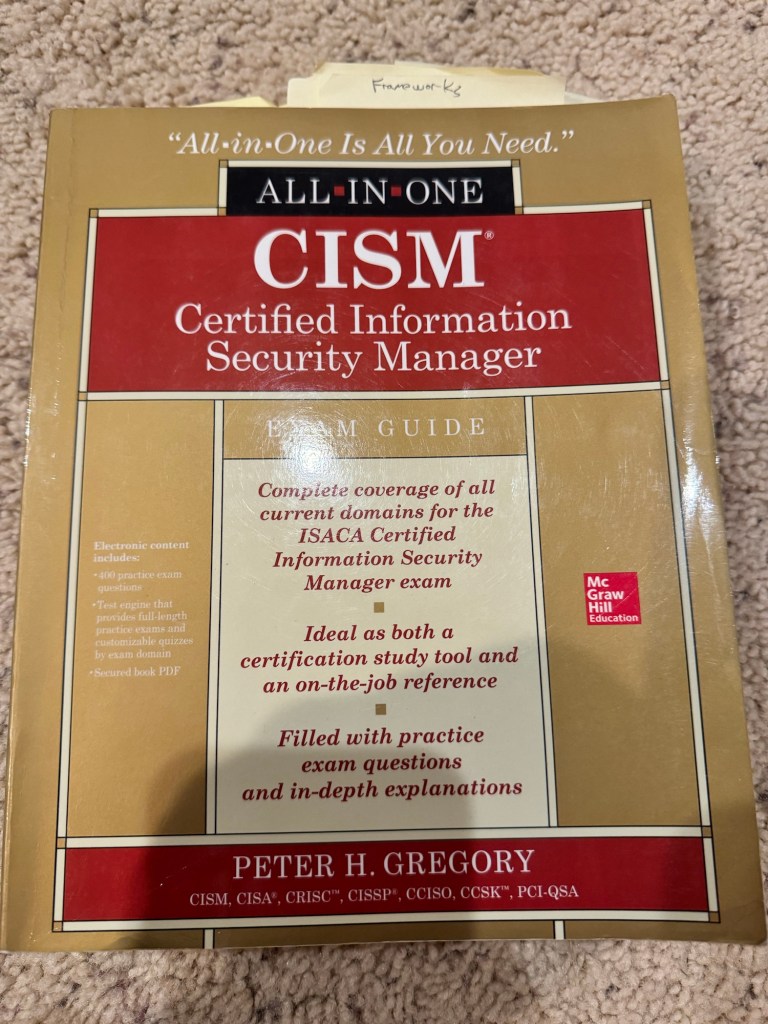
    The only book I used

    For the CISM, studying consisted of the All-In-One guide, along with the official ISACA Questions and Explanations (QAE) bank.

    The latest guide can be found here:

    http://CISM Certified Information Security Manager All-in-One Exam Guide, Second Edition https://a.co/d/032VneNc

    As of today, the QAE bank is $299 USD for members and $399 USD for non-members. I highly recommend for paying for the ISACA membership first ($145 USD), at least for year one. You can find out more here:

    https://store.isaca.org/s/store#/store/browse/cat/a2D4w00000Ac6NNEAZ/tiles

    With the ISACA membership, you get discounts on most products, including exam fees and renewals. You also get access to free webinars, local ISACA chapter events, and other CPE-earning opportunities at low or no fee.

    There are sample questions for free and other “pay to play” material via ISACA and other means. However, my best advice is to always keep things simple.

    When I received the book, I dove right in. Over a couple of months, I read the entire thing and performed each set of practice questions at the end of the chapters. At the time, I was a Reservist in the Navy, which meant a lot of downtime. I was able to handle a huge chunk of these studies during drill weekends. Looking back, I don’t know if I’ll ever swear by reading an entire study guide cover-to-cover, but here we are. I called them “intentional reading sessions”.

    If you’ve read my CISSP synopsis, there are a lot of similarities here, but there was no battle. There was no fight. There was no lack of understanding.

    After reading the full study guide, I entered a “drill and kill” mode in the QAE bank, doing reps of 10-20 questions until I was comfortable. I would study during lunch and in the evenings, mostly. Full disclosure- I was actually doing quite poorly at first, but “reset” the QAE bank about midway and my scores improved.

    After being exposed to all 800 or more questions (it is now over 1,000), I was scoring well above 80 percent on the practice exams. I would go back into the book and re-read the topics of contention, and then I scheduled my exam.

    The Exam

    The exam itself is timed for four hours and 150 questions. Unlike the CISSP, it is NOT a Computer Adaptive Test (CAT) format. Basically, what you see is what you get. Everyone has four hours and 150 questions, no matter what. It does not shift scope based on your answers, while CISSP can sense towards what you are getting wrong, and hone in on that topic. The exam will not end early. You will see the full 150 questions.

    Going into the exam, I was confident. Granted, it was years ago, but I don’t remember too many questions that threw me for a loop. Nothing was surprising. It was still a long, challenging exam, however. I do not recall how long it took me, likely around two hours or less. I did not come close to the time limit whatsoever.

    This is a bit anticlimactic, but I passed. I was both proud and grateful to be done, meeting the requirements to keep my job in the DoD (yes, seriously). I also learned some valuable stuff that I still use today. Bonus- ISACA is even kind enough to share your actual score. I shattered the minimum.

    Summary

    I’d like to reiterate that my career has been very, very unconventional. I’ve been a “jack of all trades” administrator on a submarine, who basically fell into Governance, Risk, and Compliance (GRC) after applying for positions out of the military. Everyone’s journey is different.

    If your journey lies in GRC, management, or another non-technical facet of Cybersecurity, the CISM could be the right path. I wouldn’t say it’s easy, not by a long shot. It takes months of preparation and heavy reading.

    Additionally, it is pricey ($575-$760 USD), so only do it if you are truly ready to invest in yourself. If you have an employer cover the costs, definitely take the opportunity to explore an ISACA certification. I learned a lot on the way, and will continue to learn. Overall, the answer to the title is a resounding “Yes”. It was worth it and I will continue to hold the certification. In my studies, I became more confident in communicating and assessing cyber risk to multiple audiences. You can too.

    In the future, I look forward to writing more, and diving into multiple topics. Feel free to reach out anytime.

    • Mark E .

  • Preface

    I’ve had this one in my head for a while. Essentially, I’ve described what I did, and most importantly what NOT to do while pursuing the CISSP, or any other professional certifications for that matter. It mostly boils down to eliminating procrastination and maintaining positivity. I really hope this can help someone out there.

    Starting the Journey

    When I was a young government contractor, I always looked for the next step. I still am, for the most part, learning to savor the process more and enjoy life. I came into the Civilian workforce with the basics- a successful 8-year enlistment in the Navy, Security+ certification, and a solid IT foundation. I had planned to become a direct Government employee as soon as possible and knew many who had “upward” mobility held the coveted CISSP. Therefore, I started dipping my toe into practice questions but was in for a rude awakening.

    Taking it a Bit More Seriously

    Monolithic slab of books.

    After leaving my contractor position, I had finally “made it” to where I wanted to be- the coveted GS, Civil Service pay scale. However, it wasn’t until a couple of more years that a certification of that magnitude became a hard requirement, meaning my job literally depended on it.

    In early 2019, I was able to attend a “Boot Camp” for CISSP, which consisted of roughly two working weeks of content. For the two years before that, I was focusing on some things. I was heavily content and concentrated on my job and cycling in/out of college courses. In fact, I was in college courses DURING the Boot Camp. That was a bad call.

    Had I been focused, the Boot Camp would have worked wonders. The instructors were great, and the other attendees really knew their stuff. The ones I know who passed (the CISSP exam on) the first try were surely in the correct mindset and lightyears ahead of me when it came to studying maturity. I had skimmed some of the Official Study Guide, sure, and again dipped my toe into random practice questions before the Boot Camp.

    The Exam- Initial Attempts

    During the Boot Camp, it was advised that we did not wait more than a few weeks to a month to test, otherwise we would risk losing comprehension of the material. Of course, I took the advice, especially since I had a family vacation shortly following. Luckily, work paid for that attempt (and two more). A word of advice- when studying for the CISSP, try not to have anything else going on other than your normal job. Hey, we all need to get paid, right? The goal is to have as little distraction as possible.

    The first attempt was an absolute nightmare. Honestly, it felt like I got the wrong test, and nothing I had ever studied for in my life. My palms were clammy. My heart was racing and I just wanted to get out of there. I will say that the testing algorithm allowed me to complete the maximum amount of questions, 150. I suppose it thought I had some hope. Following my summer vacation, the second attempt actually felt worse, after more futile scatter-brained study methodologies. I’d like to note that I did have many coworkers in my corner, however. I was also going through a lot in my personal life. Again, the test allowed me to complete the maximum questions.

    Side Quest: The CISM

    A less-monolithic slab of books. One book.

    After my second CISSP failure, I had one more exam attempt funded by the Federal Government. I did some research on next steps. A co-worker had recently passed Certified Information Security Manager (CISM), and also got picked up by a very large company that I will not name. I will say they build a vast majority of commercial planes in the US.

    After doing some digging, I liked the sound of the CISM. Studying was a breeze with just a book and the official Questions and Explanations from ISACA. I quickly blew that test out of the water.

    I’ll likely write a piece on the CISM in the future. Overall, it is highly relevant to my job and absolutely made me better. The ISACA community, webinars, and learning ecosystem is top-notch as well. I highly recommend pursuing at least one of their (ISACA) certifications in your career.

    More Studying and Procrastination

    Over the next couple of years, I continued to dip my toe in and out of studying. Over those years, I can honestly say I read, or at least touched, every one of the 1,000+ pages in the Official Study Guide and drilled over 1500 questions. You do NOT need to do that.

    Destination Certification and an All-Out Grindfest

    It was roughly March or April, and I had reviewed some of the world famous CISSP Mind Maps on YouTube. One of the videos brought up the topic of a “mini” crypto masterclass https://destcert.com/mmc-cryptography/

    I highly enjoyed the format and true/false knowledge assessments, which gave me the feel of the ISC2 logic of the real deal. After completing the mini masterclass, I also downloaded the companian apps of questions and flashcards. It was the practice questions that really made me realize “I don’t know shit.”

    Of course, I knew more than shit, though that didn’t stop me from purchasing the entire Master Class. I am also my own harshest critic, by a long shot. Over the next few months, I went through the videos of every domain, performing each knowledge assessment as I finished the videos. I then focused on grinding out all 600+ practice questions provided by Destination Certification. I would then go back to watch video or review the Official Study Guide on my weak points. Mine was mostly domains 3 and 4.

    I was scoring and rationalizing about 80% proficiency on ANY random sampling of reputable questions. Prior to Destination Certification, I was scoring around 70-80% on Boson and the official practice questions as well, but could not rationalize that great. Brute-force memorization is futile here. Around April, I scheduled my exam.

    The Exam

    For me, it was a Monday. I recommend taking the day off work and having a restful weekend prior. New week, new you, right? The feel of the test was still similar to that of my 2019 failures, but I was infinitely more prepared. Below are some tips for that:

    During the test, stay calm. It’s MADE to jack you up. You’ll find yourself extremely disturbed at most questions and say to yourself, “I did not study this” or “There’s no way I read this.” It’s made to do that. You’ll feel like a fraud. A punk that doesn’t deserve a seat at the table. Just stay positive and focus on your “why”. Additionally, like the first two attempts, it is a bit more technical than many lead-ons, especially if you don’t work the technical side much. Focus on rationalizing like you would through practice questions. They are not the same, however.

    For rationalizing questions, I recommend the “50 Hard Questions” that many know and love by Andrew Ramdayal https://www.youtube.com/watch?v=qbVY0Cg8Ntw and apply it to your practice questions during study. IT WORKS! It holds even more true during the real deal. Even if the real deal question makes no technical sense to you, use this methodology.

    By the time I got to question 100, with sporadic bouts of self-doubt and rage, I clicked the Next button. I figured it could be either really good or really bad after.

    After question 100, the test finished. It finished. I couldn’t believe it, but knew what would be on that printer, on the other side of that wall in the testing center. Bliss. Freedom from an 8-year burden.

    Summary, Peace, and Creativity

    You don’t need dozens of sources for this exam. Pick one book, and buy the Destination Certification class. If your employer will cover some of the costs, great. If not, I want you to think about something. If Cyber is your career for the long-haul, the cost of NOT investing in yourself and career is much, much greater than spending $1000-$2000 on career growth. Just think about it. By all means, KEEP IT SIMPLE when it comes to study material!

    Stay as calm as possible during the exam. Breathe. Know that you have about a minute and change for each question. I took a break at question 80 and finished in about two hours. If a question is frustrating, do your best to narrow the options to two and make your best guess. There’s zero penalty for that.

    This summer, I look forward to being present for my family, improving at my job, and learning/creating—best of luck to you. You do NOT have to take 8 years of studying to get this cert. Realistically, like 6 months.

    If you made it this far, I sincerely thank you. It’s my hope that you find value in this during your studies. Even if you’ve already done it, please share with those who haven’t.

    – Mark E.